
How Low-Pressure Roof Cleaning Extends Your Roof's Lifespan in Cape Coral
Cape Coral homeowners deal with a roof cleaning problem that most of the country doesn't face at the same intensity: year-round biological growth that never gets a cold-weather reset. Algae, mold, mildew, and lichen thrive continuously in Southwest Florida's humid subtropical climate, and without regular maintenance, that growth quietly does structural damage that shortens a roof's useful life by years.
The method used to clean that growth matters as much as cleaning it at all. Soft wash roof cleaning — low-pressure application with professional-grade biocidal solutions — is the approach that removes growth safely while extending the roof's life. High-pressure washing does the opposite: it removes visible staining while causing the kind of physical damage that compounds over time.
Here's the full picture of why pressure matters, what soft washing actually does at the material level, and how Cape Coral's specific climate shapes the maintenance schedule your roof actually needs.


What High Pressure Actually Does to Roofing Materials
The intuition behind pressure washing a roof is understandable — you can watch the staining disappear in real time, and the result looks clean immediately. The problem is what's happening to the roofing material underneath.
Asphalt shingles are coated with ceramic granules that protect the underlying fiberglass or organic mat from UV degradation. Those granules are bonded to the asphalt layer, but not permanently — they're designed to weather naturally over 20–30 years, not to absorb direct water impact at 2,000–3,000 PSI. A single pressure washing session can accelerate years of granule loss. Once granules are stripped, the asphalt mat beneath absorbs UV radiation directly, becomes brittle, and begins to crack. Granule loss is visible in your gutters and downspouts as a sandy sediment — a direct indicator that shingle lifespan is being shortened.
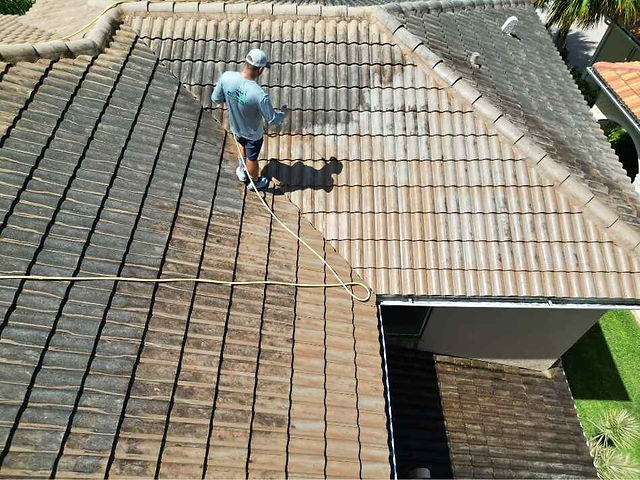
Concrete and clay tile may seem more durable, but high pressure creates different problems. It forces water into the micro-pores of the tile surface, pressurizes water under overlapping tile edges, breaks the seal at mortar joints and ridge caps, and can crack or dislodge individual tiles — damage that isn't always visible from the ground but creates leak paths into the underlayment. Concrete tile in particular is porous; once the surface is opened by pressure washing, it absorbs moisture faster and becomes more hospitable to future algae growth.
Metal roofs are vulnerable to panel denting, fastener stress, and coating damage under high pressure. Standing seam roofs can have seam integrity compromised by sustained direct pressure, and once a factory coating is stripped, oxidation accelerates.
Soft washing uses 40–80 PSI — roughly garden-hose pressure — which applies solution to the surface without the mechanical force that causes any of these problems.
What Soft Washing Does That Pressure Washing Can't
The key distinction between soft washing and pressure washing isn't just the PSI — it's the fundamental mechanism of cleaning.
Pressure washing is mechanical. It removes biological growth by physically blasting it off the surface. Surface cells are disrupted and washed away, but root-level cells embedded in the texture of the roofing material remain. Growth rebounds quickly because the colony was disturbed rather than killed, and the wet surface left behind is immediately hospitable to regrowth.
Soft washing is chemical. A professional-grade biocidal solution is applied to the roof surface and given appropriate dwell time to penetrate the colony and kill it at the cellular level — including the root cells embedded in the roofing material. The solution breaks down organic growth from the inside out rather than blasting it from the outside in.
The practical difference in results is significant:
Longevity: Properly applied soft wash results typically last 18 months to 3 years in Cape Coral's climate. Pressure-washed roofs frequently show visible regrowth within 3–6 months because the underlying colony was never eliminated.
Material integrity: No granule loss, no cracked tile, no stressed seams or fasteners. The roofing material is left in the same physical condition it was in before cleaning — just without the biological growth.
Depth of clean: A soft wash treats the full depth of the roofing surface rather than just the top layer, which means early-stage growth invisible to the eye is also eliminated before it can establish visibly.
How Organic Growth Shortens Roof Lifespan — Step by Step
Understanding why soft washing extends roof life requires understanding exactly how untreated growth damages it.
Stage 1 — Algae establishment (months 1–12 after spore landing): Gloeocapsa magma spores settle on the roof surface, particularly in shaded or north-facing sections where moisture stays longest. The colony establishes in the texture of the roofing material and begins feeding on limestone filler in shingles or colonizing tile micro-pores. No visible staining yet.
Stage 2 — Visible streaking (months 6–18): As colonies mature, they produce a dark pigmented sheath that becomes visible as black or dark brown streaking. At this stage the colony is actively feeding on roofing materials and holding moisture against the surface, increasing heat absorption in stained areas and beginning to accelerate granule loosening on shingles.
Stage 3 — Moisture trapping and secondary growth (year 1–3): Established algae retains moisture longer after rainfall, creating sustained wet conditions that support secondary growth — particularly lichen. Unlike algae, lichen bonds chemically to roofing material, embedding rhizines (root-like structures) into tile and shingle surfaces. Lichen damage is physically more severe and significantly harder to remove than algae alone.
Stage 4 — Structural impact (year 3+): Sustained moisture retention, ongoing granule loss, lichen bonding damage, and heat absorption all compound. On shingle roofs this manifests as curling edges, cracking, and accelerated aging. On tile roofs, weakened mortar joints, cracked tile faces, and compromised underlayment become increasingly common.
Soft washing at Stage 2 — when staining first becomes visible — prevents the progression to Stages 3 and 4 entirely. Each year of deferred treatment allows more structural damage to accumulate.
The Energy Efficiency Benefit
A benefit that's often overlooked: a clean roof runs cooler.
Dark algae colonies on light-colored tile or shingle roofs absorb significantly more solar radiation than clean surfaces. In Cape Coral's climate, where summer sun is intense and extended, a heavily stained roof increases attic temperatures measurably — which raises cooling loads throughout the home. Studies on roofing heat absorption have documented meaningful differences in attic temperature between clean and algae-stained surfaces of the same material.
Soft washing restores the original reflectivity of the roof material, reducing heat absorption and modestly improving energy efficiency. On tile roofs in particular — where light barrel or flat tile is common in Cape Coral neighborhoods — this effect is most pronounced.
Warranty Protection
Most asphalt shingle manufacturers include cleaning method guidance in their warranty documentation. Damage caused by pressure washing — specifically granule loss attributable to mechanical cleaning — gives manufacturers grounds to deny claims, even years after the cleaning occurred. Soft washing follows the low-pressure, chemical-based approach that manufacturer guidelines recommend, which keeps your warranty protection intact.
This matters most when a significant repair is needed several years after a cleaning. If the cause of shingle failure can be traced to granule loss, and there's a record of pressure washing, the warranty claim pathway closes.
How Often Does a Cape Coral Roof Need Soft Washing?
For most Cape Coral homes with reasonable sun exposure, annual soft washing is the right interval. For properties with heavy tree coverage, canal or waterfront exposure, or multiple north-facing slopes that stay shaded, cleaning every six months keeps growth from establishing between visits.
The detailed breakdown of what affects your specific cleaning schedule — including the warning signs that mean your roof needs attention before its next scheduled cleaning — is covered in our how often should you clean your roof in Cape Coral guide.
The consistent principle: acting early at the first sign of streaking is always cheaper and less invasive than waiting until growth has progressed to secondary lichen development or structural impact.
What a Professional Soft Wash Includes
A complete professional soft wash for a Cape Coral home includes steps that matter beyond just applying solution:
Property preparation: Pre-rinsing and covering plants, shrubs, and landscaping below the roofline to protect against chemical runoff
Solution application: Professional-grade biocidal mix applied at low pressure with appropriate dwell time for the specific roof material and growth level
Controlled rinse: Low-pressure post-rinse once the solution has completed its work, managing runoff direction and volume
Post-clean walkthrough: Visual inspection to confirm complete coverage and identify any areas that may need a second application
AAA Roof Cleaning services Cape Coral, Fort Myers, Punta Gorda, Pine Island, and surrounding SWFL communities with soft washing exclusively — no pressure washing on roofs, on any material, for any reason.
Request a free estimate to find out what your roof's current condition looks like and what soft washing will cost for your specific home.


